
When Does a Heatwave Actually Happen — and Why Does It Matter Which Month?
European summers are increasingly characterized by prolonged heatwaves, droughts, wildfires, and growing pressure on public health systems. However, it is often overlooked that a heatwave in June and a heatwave in August are not the same phenomenon, as they are influenced by various drivers to different degrees. Understanding these distinctions has direct implications for forecasting and climate risk assessment.
In our study, we analyzed Central European heatwaves from May to September using 73 years of ERA5 atmospheric data (1950–2023). We investigated how the relative roles of the factors leading to extreme heat evolve throughout the season.
We combined three complementary approaches. The first is atmospheric persistence: how long a weather pattern tends to remain stable before transitioning. The second, the co-recurrence ratio, quantifies how often similar large-scale atmospheric circulation patterns are accompanied by similar surface temperature patterns. It is a statistical tendency rather than a direct causal link. Both measures are derived from dynamical systems theory (Faranda et al., 2024).
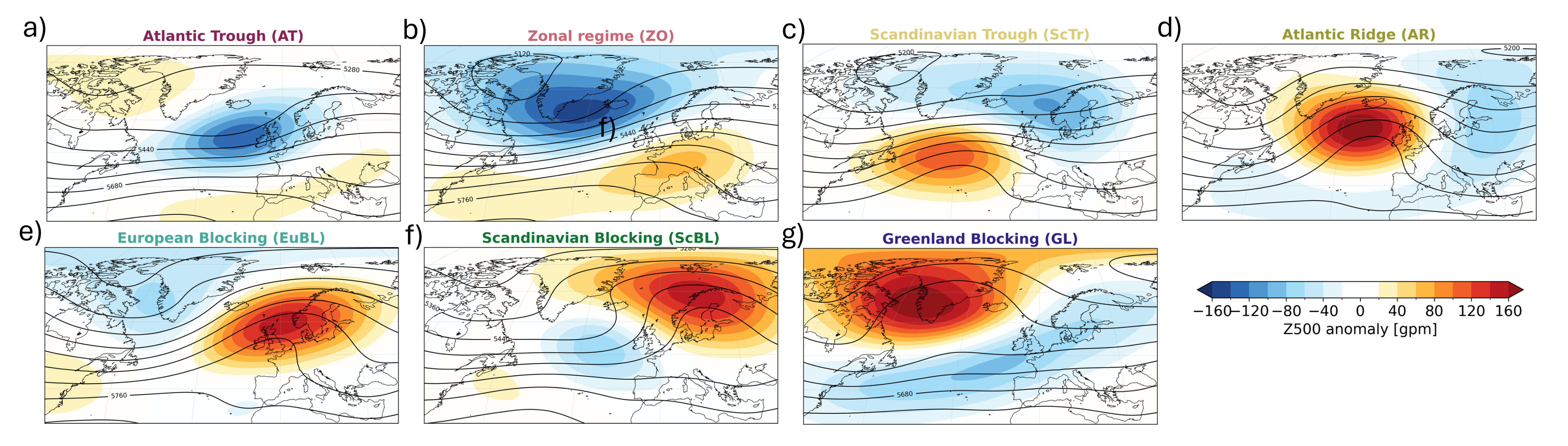
Third, we investigate weather regimes (Figure 1): quasi-stationary, large-scale configurations of the atmosphere over the North Atlantic and Europe, capturing the dominant modes of large-scale atmospheric circulation variability.
The atmosphere has a memory — and it changes through summer
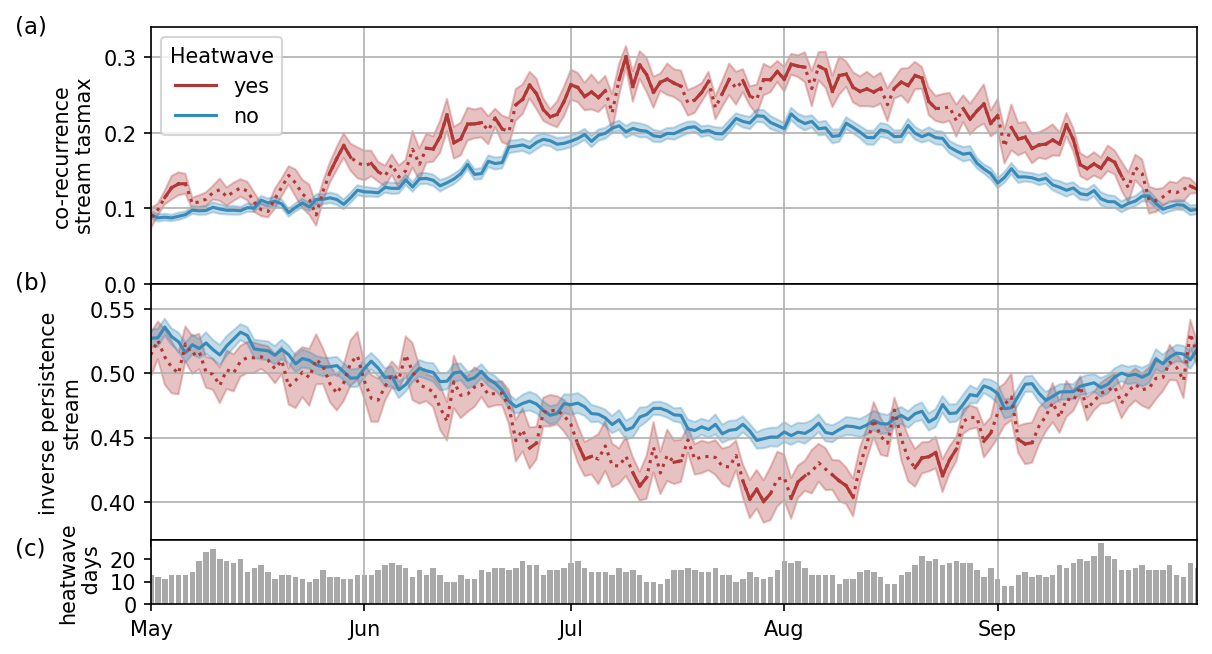
Both atmospheric persistence and the atmospheric circulation–temperature relationship show a pronounced seasonal cycle, with minima in spring and autumn and a peak in July and August. This coincides with an increased occurrence of Scandinavian Blocking (Fig. 1f), a persistent high-pressure system associated with stable conditions and sustained surface warming across northern Europe.
However, the dominant weather regimes can vary substantially by month. May features a complex mixture of blocking and more transient regimes, while these patterns are least frequent by September. Similar persistence levels can therefore arise from quite different atmospheric configurations depending on the time of year.
And what about heatwaves specifically?
During heatwaves, atmospheric persistence is only anomalously elevated in July and August (Fig 2b), when Scandinavian and European blocking regimes (Fig 1 e,f) occur most frequently. In contrast, the co-recurrence ratio between atmospheric circulation and temperature is significantly enhanced during heatwaves from June through September (Figure 2a).
This suggests that mid-summer heatwaves are both unusually persistent and strongly linked to atmospheric circulation patterns, whereas early- and late-summer heatwaves exhibit weaker persistence despite maintaining a strong circulation–temperature relationship. The specific weather regimes driving this enhanced co-recurrence ratio also differ by month: While European blocking produces heatwaves with a strong link to atmospheric circulation in early summer, the more variable Zonal Regime (Figure 1b) takes its role by September.
Beyond the atmosphere: The Role of Surface Conditions
Still, the atmospheric circulation alone does not tell the full story. We also examined how surface variables co-vary with temperature during heatwaves.
Solar radiation is strongly linked to heatwave temperatures from May through August, peaking in late June. Soil moisture patterns co-occur with temperature patterns most strongly from June to August and intensify toward late summer, consistent with the role of dry soils in amplifying heat through reduced evaporative cooling.
In addition, July and August heatwaves are characterized by suppressed nighttime cooling, in contrast to September.
Takeaway
Taken together, European heatwaves in mid-summer (July–August) are associated with a combination of persistent blocking, strong atmospheric circulation–temperature coupling, co-occurring dry soils, and suppressed nighttime cooling. Early and late summer heatwaves operate under a different configuration; more strongly associated with insolation, weaker persistence signals, and distinct atmospheric circulation regimes.
These findings highlight that the timing of a heatwave within the season must be explicitly accounted for when predicting, communicating, and responding to heat extremes.
The results are published in Dillerup, I., Lemburg, A., Buschow, S., and Pinto, J. G.: Dynamical system metrics and weather regimes explain the seasonally-varying link between European heatwaves and the large-scale atmospheric circulation, Earth Syst. Dynam., 17, 265–289, https://doi.org/10.5194/esd-17-265-2026, 2026.
This study is part of the ClimXtreme 2 DySyTEx Project.
References
Faranda, D., Messori, G., Alberti, T., Alvarez-Castro, C., Caby, T., Cavicchia, L., Coppola, E., Donner, R. V., Dubrulle, B., Galfi, V. M., Holmberg, E., Lembo, V., Noyelle, R., Yiou, P., Spagnolo, B., Valenti, D., Vaienti, S., and Wormell, C.: Statistical physics and dynamical systems perspectives on geophysical extreme events, Phys. Rev. E, 110, 041001, https://doi.org/10.1103/PhysRevE.110.041001, 2024.
Grams, C. M., Beerli, R., Pfenninger, S., Staffell, I., andWernli, H.: Balancing Europe’s wind-power output through spatial deployment informed by weather regimes, Nature Climate Change, 7, 557–562, https://doi.org/10.1038/nclimate3338, 2017.
Osman, M., Beerli, R., Büeler, D., and Grams, C. M.: Multimodel assessment of sub-seasonal predictive skill for yearround Atlantic–European weather regimes, Quarterly Journal of the Royal Meteorological Society, 149, 2386–2408, https://doi.org/10.1002/qj.4512, 2023.