
How does Saharan dust influence climate in Europe?

Every year, large amounts of mineral dust are emitted in the Sahara and transported in various directions, including towards Europe. Dust has a significant impact on the Earth’s radiation balance. It can scatter and absorb both longwave and shortwave radiation, leading to local cooling or warming. Furthermore, dust acts as ice nucleating particle and cloud condensation nuclei, thereby influencing the formation and properties of clouds. As a result, it can affect weather and climate. However, its optical properties, which describe how dust interacts with radiation, can vary greatly and are determined by other particle characteristics, such as shape, size, and mineralogical composition. Many of these properties of dust particles are not yet fully represented in current models or are represented with simplifications, leading to uncertainty in estimates of the total radiative effect of mineral dust. Of particular interest, for example, are giant Saharan dust particles with diameters exceeding 62.5µm, which, despite their size, can travel long distances through the atmosphere. Due to their size, they absorb radiation more strongly than smaller particles and thus have a warming effect on climate.
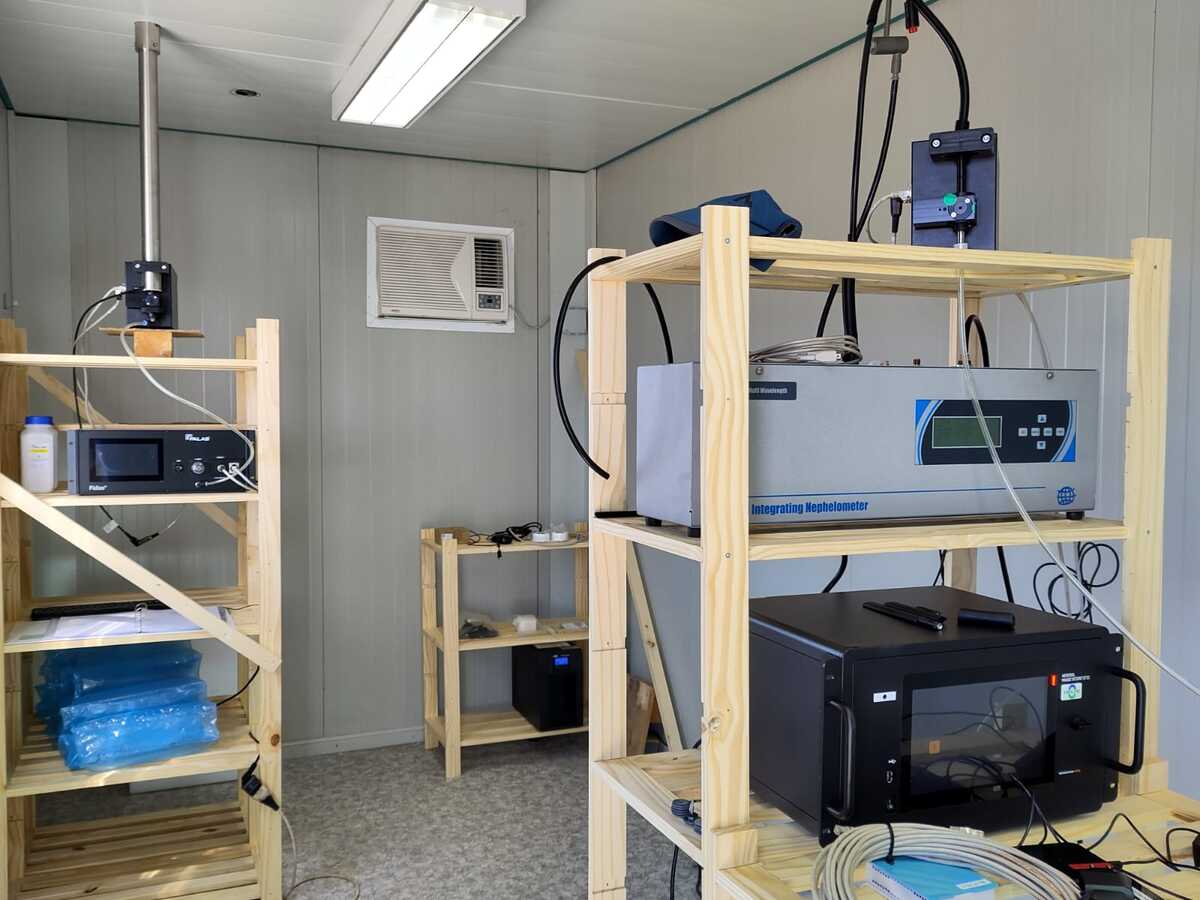
The international DUSTIMPACT project, jointly funded by the German and Spanish research councils (Deutsche Forschungsgemeinschaft and Agencia Estatal de Investigacion), brings together partners from Germany and Spain to more accurately determine the properties and regional climate impact of Saharan dust particles by combining measurements and modeling. As part of the project, the project partners from KIT, the Technical University of Darmstadt, the Barcelona Supercomputing Center, and the Institute of Environmental Assessment and Water Research (IDAEA-CSIC), installed measuring devices at four observatories in Europe.
In mid-May 2026, a group of project partners met at the Izaña Meteorological Observatory in Tenerife to install the measuring instruments there at an elevation of 2300m. Due to an inversion layer, the observatory is largely isolated from anthropogenic influences and is therefore well-suited for measuring Saharan dust. All observatories are located along the main transport routes for Saharan dust. Tenerife in particular allows to study the westward transport of dust from Africa towards the North Atlantic. One focus of our measurements is on the precise quantification of the size distribution of the transported Saharan dust particles. For this purpose, optical particle counters are used, which can detect particle sizes up to 100µm. In addition, particles are collected using filters so that their shape and mineralogy can subsequently be examined in the laboratory.
In addition to Izaña, other instruments have been installed on mount Hoher Sonnblick in Austria, as well as on mountain sites near Granada and Montsec in Spain. Over the next 1.5 years, the instruments will provide detailed data to capture the seasonal variability of dust transport. Because they are operated in existing observatories, the measurement results can also be combined with or compared to data collected there operationally. Our measurement results will then be used to improve the representation of Saharan dust in weather and climate models and to quantify its climate impact.