
Training for a new era in weather and climate prediction
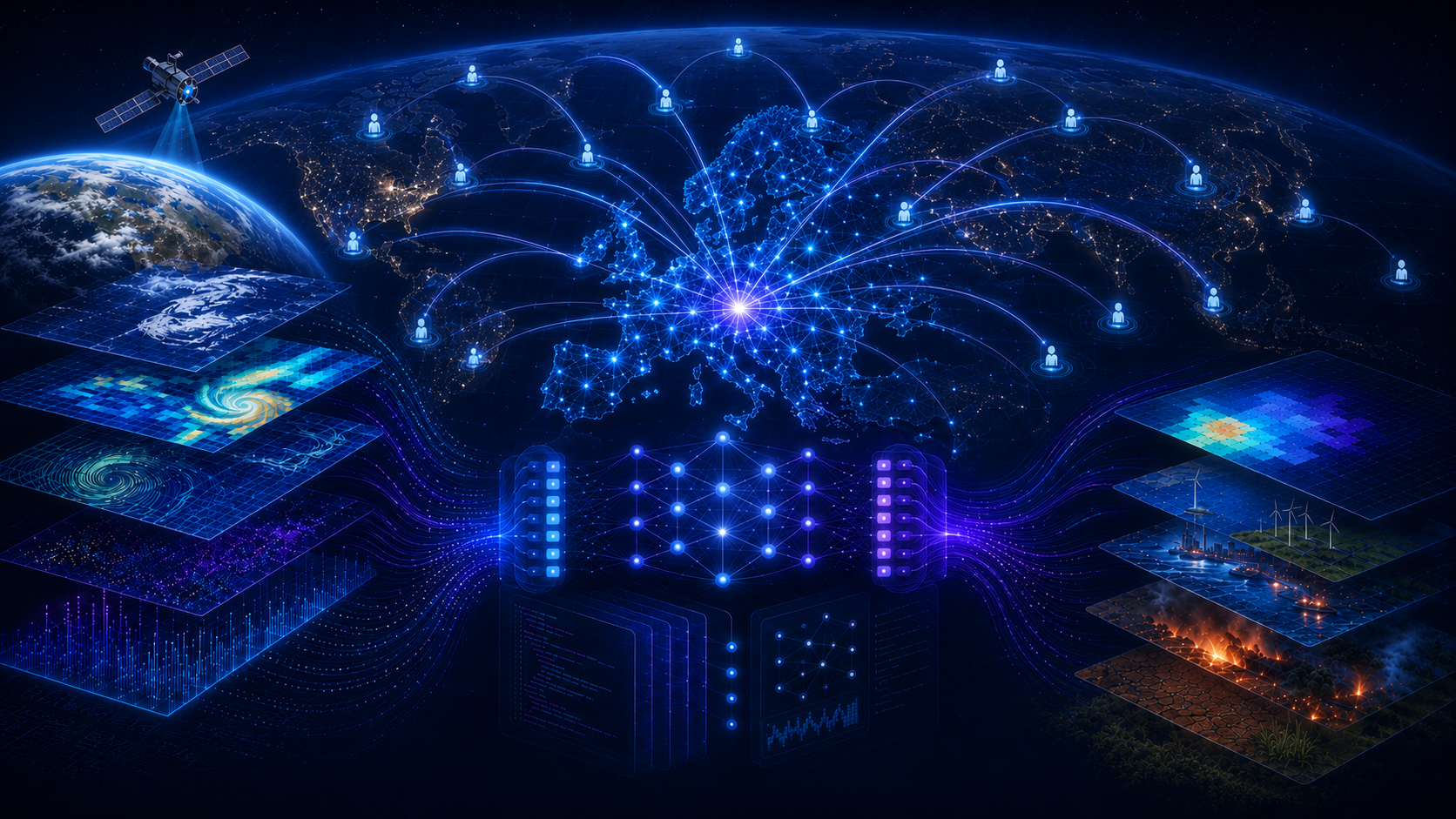
Machine learning is becoming a central part of the transformation of weather and climate science. In only a few years, data-driven approaches have moved from research prototypes to systems that can support forecasting, digital twins, uncertainty estimation, downscaling, data assimilation, and climate-impact applications. This rapid development creates new opportunities, but it also raises a practical question for the community: how can scientists, forecasters, and developers understand these methods well enough to use them critically, evaluate their limitations, and integrate them responsibly into Earth-system workflows?
The new three-course online programme “Machine Learning for Earth Systems Modelling”, running from March to December 2026, addresses this need as a structured learning pathway. KIT and Wageningen University & Research developed the course in the framework of a contract supported by ECMWF for Destination Earth. KIT is responsible for the scientific coordination of the project led by Dr. Dwaipayan Chatterjee in the Atmospheric Dynamics group.
The program is built around a clear progression. Course 1 opens the pathway by introducing machine learning in weather and climate science, explaining key concepts, the role of AI in Destination Earth, digital twins, modern AI forecasting systems, and responsible AI. It is designed to make the field accessible to a broad audience, including learners without prior coding experience, while also giving technical participants a common conceptual foundation.
Course 2 then turns this foundation into technical capability. It focuses on the architectures, datasets, and workflows behind machine-learning weather prediction systems, including neural networks, graph-based and transformer-based models, data handling, high-performance computing, uncertainty quantification, benchmarking, and frameworks such as Anemoi. Hands-on notebooks and project elements help learners move from understanding AI forecasting systems to building and evaluating simplified versions.
Course 3 connects these technical skills to advanced Earth-system applications and future research directions. It covers machine learning for extremes such as floods and wildfires, explainability and trust, foundation models, hybrid modeling, subseasonal-to-seasonal prediction, downscaling, coupled Earth-system components, ML-based data assimilation, end-to-end modeling, Forecast-in-a-Box, and data-driven discovery.
Across the program, lectures, notebooks, quizzes, webinars, panels, and podcasts connect scientific concepts with operational perspectives and community discussion. The result is not only a training offer, but a bridge between data, models, applications, and responsible decision-making, preparing learners to contribute to the next generation of trustworthy AI-assisted weather and climate prediction.